Food For Thought Newsletter Header spring fruits
Man with clipboard

Understanding Inspection Reports

An informal verbal survey was recently conducted in parts of Snohomish County. Food service establishment managers were asked the following questions:

  • What are the most important things restaurant staff can do to prevent foodborne illness?
  • Which violations do you think have the most points associated with them?
  • Did you know that red violations totaling 50 points or more requires a fee charged reinspection?

The feedback received from the verbal survey showed that there was a gap between what establishment operators think is important, and what actions are most useful to prevent foodborne illness.

Establishment managers said that hand washing, avoiding cross contamination, proper cold holding, and cleaning are the best ways to prevent foodborne illness. All of these are good answers, and they will help prevent foodborne illness. However, when looking at an inspection report, each violation has a point value assigned to it. The red violations with 25 points are the most critical violations as they may cause a foodborne illness if the processes are not done correctly. Currently, if red violations are found totaling 50 points or more, it will result in a fee charged reinspection. It is important that establishments have a good understanding of these violations to make sure that correct food safety practices are occurring in your establishment. Here's a list of all the 25-point violations.

  1. Improper hand washing
  2. Working while sick
  3. Room temperature storage (food on the counter)
  4. Improper cooling
  5. Bare hand contact with ready-to-eat foods
  6. Improper hot holding
  7. Improper cook temperatures 

Being aware of the 25-point violations can help prevent the spread of foodborne illness and make it more likely that establishments will not need to have a fee charged reinspection. If you have any further questions about how inspection reports work, please talk to your local health inspector and they will be happy to help. Additional food safety resources can be found on our website Food Safety Educational Resources | Snohomish County Health Department, WA (snohd.org)

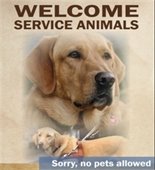
Service animal Poster

service Animals

There are many people who bring their family pet into grocery stores or restaurants and claim they are a service animal. As of January 2019, it is a civil misdemeanor to intentionally misrepresent a pet as a service animal. This misdemeanor comes with a $500 fine. The only animals that should be allowed in your facility are service animals. 

The definition, under the Americans with Disability Act (ADA), is “a service animal is defined as a dog that has been individually trained to do work or perform tasks for an individual with a disability. The task(s) performed by the dog must be directly related to the person’s disability.” This means that service animals are working animals that have been trained to perform a specific task. They are not pets. An animal that provides emotional comfort is not considered a service animal as they do not perform a specific task. We do recognize that the ADA does allow psychiatric service animals. “If the dog has been trained to sense that an anxiety attack is about to happen and take a specific action to help avoid the attack or lessen its impact, that would qualify as a service animal.”

A service animal is only allowed to be in areas where the public is allowed to go, and they must be kept in control by their owners. They are not required to be certified or trained by a specific program. They are also not required to wear identification. This makes it harder to identify a service animal. A popular concept is “Four on the floor”. This is the idea that service animals would always have all four paws on the floor unless they are performing a specific task. An example would be the person must carry the dog in a chest pack for that dog to perform their task

Under the ADA, you are only allowed to ask 2 questions to help you identify a service animal:

  1. Is the service animal required because of a disability?
  2. What work or task has the service animal been trained to perform?

You cannot ask someone about their disability or ask that the service animal demonstrate how they help that person. The best way to prepare is to understand the law, print out the questions you can ask and have information available for your other customers. We have a service animal poster for the public and a handout for employees. Find them on the Food Safety Educational Resources page of our website. The ADA also has a Frequently Asked Questions about Service Animals webpage.

The new food code does allow pet dogs in two situations. Under specific conditions, and under an approved plan, dogs can be allowed in outdoor seating areas. These conditions are important for preventing contamination and ALL the conditions must be met to safely allow dogs onto the premises. After health department notification, dogs are also now allowed inside establishments that only pour beverages produced in a licensed processing plant, such as beer or wine. There must be signs posted notifying customers that dogs are approved to come inside those establishments. The Washington State Department of Health has created a Pet Dogs on Premises template to help create plans. They also have pet dog signs to print. 

Make Sustainability Upgrades with Snohomish County’s C-PACER Program!

Looking for a way to make energy efficiency or resiliency upgrades to your food service property? Snohomish County’s Commercial Property Assessed Clean Energy & Resiliency (C-PACER) Program provides a financial tool for commercial property owners to obtain low cost financing for energy efficiency, natural disaster and resiliency upgrades that carry with the life of the property instead of the property owner.

The program creates a mechanism for capital providers, such as banks or credit unions, to offer low-interest financing for commercial property improvements that reduce greenhouse gas emissions, improve energy efficiency, increase renewable energy, promote water conservation, and encourage resiliency.

Examples of qualifying projects include electric vehicle charging infrastructure, seismic retrofits, flood mitigation improvements, fire detection and suppression, energy storage, and more. Properties must be located within Snohomish County (incorporated or unincorporated) and must be privately-owned commercial, industrial, or agricultural property or multifamily residential property with five or more dwelling units. Learn more on the C-PACER webpage and review the program guide.

C-Pacer Flow chart
food worker card icon

5-year Food worker card

To receive an extended 5-year food worker card you must first have your Certified Food Protection Manager (CFPM) certification. Here is a list of all of the ANSI approved CFPM courses.

Once you have your CFPM certificate, you must still take the food worker card class/test within 2 years of the CFPM certificate date to qualify for a 5-year card. You will receive either a 2 or 3-year card at that time. You will email Food Safety to request that we turn your 2 or 3-year card into a 5-year card. Your email must include a picture or scan of your CFPM certificate and new food worker card. If you qualify, your food worker card will be extended to a 5-year card. The food worker card class online system will email the new 5-year card to you to print out.

If you have received your CFPM certificate and currently have a valid food worker card that lasts for another 1.5-2 years, we encourage you to wait until just before that food worker card expires to retake the class/test and email us for your 5-year card. 

Styrofoam take-out containers

New food packaging laws

From coffee shops and cafeterias to restaurants and gas stations, food service often uses disposable products. While convenient, these products can create waste, add to pollution, and leach toxic chemicals into the environment. Some packaging designed to hold freshly prepared food can contain PFAS, a group of toxic chemicals. PFAS (per- and polyfluoroalkyl substances) are toxic chemicals sometimes used for greaseproof and waterproof coatings on food packaging. PFAS can cause health problems like higher cancer risk, weaker immune response, and lower birth weight. 

People can be exposed to PFAS when eating food from packaging that contains PFAS. Food packaging can also release PFAS into soil and groundwater where it builds up in animals, people, and plants. That’s why Washington passed a law prohibiting the manufacture, sale, and distribution of certain food packaging containing PFAS.

Washington has new requirements every food service establishment should know about. As of Feb. 1, 2023, certain types of food packaging were banned if they have PFAS intentionally added. These included wraps, plates, food boats and pizza boxes.

On May 1, 2024, the following products are also banned if they have PFAS intentionally added:

  • Bags and sleeves.
  • Bowls.
  • Flat serviceware, including items like plates and trays.
  • Open-top containers, like french fry cartons and food cups.
  • Closed containers, like clamshells.

 Manufacturers of these products must certify their products comply with the law. If you’re purchasing these products, ask the manufacturer for their certificate of compliance. For more information, visit our PFAS in food packaging law webpage or email hwtrpubs@ecy.wa.gov.

 On June 1, 2024, expanded polystyrene food service products such as cups, plates, to-go clamshells, trays, food containers, and single-use coolers will be banned for sale and distribution in Washington. Expanded polystyrene (EPS), often mistakenly called Styrofoam™, is a type of foamed plastic used in takeout food containers and packing peanuts. While expanded polystyrene can be recycled, it is expensive and not accepted in most curbside recycling programs. For more information and a list of alternative products, visit the expanded polystyrene ban webpage or email epsban@ecy.wa.gov.


Notify Me

Sign up to receive this newsletter using the Notify Me page.

Share on Facebook
Share on Twitter
Share via Email

Snohomish County Health Department
3020 Rucker Ave., Everett, Washington

Powered by
CivicSend - A product of CivicPlus