The Child Care Health Newsletter Banner
Snohomish County Health Department logo

June 2024

Click here to visit our website

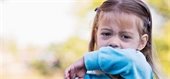
Little girl sneezing into her elbow

PROTECT YOURSELF AND CHILDREN FROM WHOOPING COUGH

Please be aware of an increase in pertussis reported in some areas of Washington State, including Snohomish County. Better known as, “Whooping Cough,” individuals with a history of receiving pertussis vaccine can still get pertussis.

Whooping cough (pertussis) is a disease that spreads easily from person to person by coughing and sneezing. It can be very serious for babies and cause coughing spells that make it hard to eat, drink, or breathe. Hundreds of babies are hospitalized each year for whooping cough, and some die from it.

Many teens and adults don’t realize they have whooping cough because their symptoms are mild. Some teens and adults will have severe coughing that leads to vomiting or broken ribs. Even worse, they can spread whooping cough to babies at home or in their care.

Everybody in the child care center should be vaccinated against whooping cough to protect themselves and children. The Tdap vaccine, for teens and adults aged 11-64 years, includes a tetanus and diphtheria booster and also protects against whooping cough. Ask your doctor, nurse, or clinic if it’s time to get your Tdap vaccine.

Make Sure Children are Up-to-Date on Their Immunizations

Infants and toddlers need four shots to protect against tetanus, diphtheria, and whooping cough. They also need a booster shot before starting kindergarten. Whooping cough is spread by coughing and sneezing. Protect yourself and others from whooping cough:

  • Cough and sneeze into your sleeve, instead of your bare hands.
  • Throw away tissues after each use.
  • Wash your hands often with soap and water.

More information on pertussis (whooping cough) is available from the Centers for Disease Control and Prevention.

If you have questions about vaccines or need any assistance in determining vaccination status please reach out to our team at 425.252.5415 or by email at shd.childcarehealth@co.snohomish.wa.us


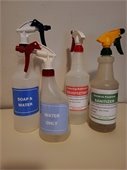
Bottles of bleach sanitizer on a counter

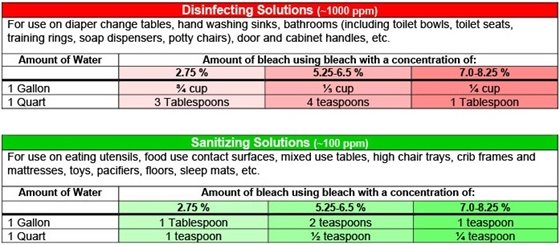
Bleach chart update

Consider a different, safer disinfectant… but if you use bleach there is a NEW CHART

Over the past several years, there are many newer and safer sanitizer and disinfectant choices available on the market. The preferred choices for facilities with young children, like schools and child cares, are products with ethanol or hydrogen peroxide as their main ingredients. The Washington State Department of Health has a resource called Cleaning, Sanitizing, and Disinfecting for Child Cares - Guide for Early Care and Education Providers (PDF) that gives excellent guidance. One thing you can look for to help you decide on a safer product is a third-party certification logo such as the ones at the bottom of this article.

Here are some more resources for choosing safer alternatives:

  • Environmental Protection Agency – DfE-Certified Disinfectants – these are disinfectants that are safer for both humans and the environment. You can find a lot of disinfection products that contain the “safer” ingredients. https://www.epa.gov/pesticide-labels/dfe-certified-disinfectants
  • San Francisco provides lists of approved safer products for their departments and contractors: https://sfapproved.org/
  • Informed Green Solutions – this organization has a lot of information about safer cleaning and disinfecting for child care facilities. https://www.informedgreensolutions.org/toolkit
  • Responsible Purchasing Network - http://www.responsiblepurchasing.org/  
  • The University of Washington has an excellent handout on safer cleaning, sanitizing, and disinfecting- https://osha.washington.edu/sites/default/files/documents/Updated%20Safer%20Disinfectants%20List_March%2026%2C%202020.pdf
  • Toxic Use Reduction Institute - https://www.turi.org/Our_Work/Cleaning_Laboratory/Safely_Clean_Disinfect/Safer_Disinfecting_Products/List_of_Safer_Disinfecting_Product

If your child care continues to use bleach, please be aware that the bleach and water mixing chart has been updated to reflect Centers for Disease Control and Prevention recommendations following the COVID-19 pandemic. The sanitizer strength recipe concentrations, which are the main ones that should be used in your child care during the day, have not changed. The disinfectant strength levels are now slightly higher and match those that were used during the pandemic. The disinfectant strength should only be used during the day on diapering surfaces and as needed on bathroom surfaces. Most disinfection should be done at the end of the day when children are no longer present in the room. As always, make sure staff have proper safety equipment, like goggles, gloves, and an eye wash available when mixing bleach solutions. Also note that the colors associated with the strengths have changed. Disinfection is now RED to indicate - - use cautiously and the sanitizer strength is light GREEN to indicate that it is a less concentrated solution. 

Here is the link to the updated chart: 

https://doh.wa.gov/sites/default/files/legacy/Documents/8340/970-216-Disinfect-en-L.pdf

New labels can be found on our website: https://www.snohd.org/261/Safety-Sanitation

bleach chart
Green Seal Certified Logo
Design for the Environment EPA logo
UL Ecologo Logo

When was your water Last Tested for Lead and Copper?

Child care licensing regulations require child care facilities to have their water tested for lead and copper at least once every 6 years. It has been 7 years since this rule went into effect (May 2017). If you haven't had your water tested recently, it may be time to do so again.

The Washington State Department of Health Lead in Child Care Drinking Water program continues to offer free mail-in water testing for child care and early learning sites across the state. License-exempt preschool and early childhood programs are also eligible to participate. The testing program checks for the presence of lead and copper in water used for cooking and drinking and fulfills licensing requirements for the Department of Children Youth and Families. For more information or to register for the program: Lead in Child Care Drinking Water | Washington State Department of Health

Flyer image for Washington State Department of Health Child Care Water Testing Program for lead and copper
COVID germ

COVID-19 INFORMATION AND RESOURCES

Remember to report any outbreaks and medically diagnosed cases of COVID-19 that occur at your child care or early learning facility via our website.

The Washington State Department of Health has updated the guidance for K-12 Schools, child care and early learning facilities regarding respiratory illness, including COVID-19. For more information please see the Health Alert sent out 4/2/2024.

If you are not signed up to receive health alerts from our team, you can do so on our website.

More information on updated COVID-19 guidance can be found in Snohomish County Health Department's Blog: Public Health Essentials

If you have questions about these guidance changes, or would like assistance in updating or implementing your health policy, please reach out to our team at 425.252.5415 or by email at shd.childcarehealth@co.snohomish.wa.us
FREE TEST KITS FOR CHILD CARES - LIMITED SUPPLY REMAINING 

Child cares can request COVID-19 tests to share with families at no charge through the Snohomish County Health Department. To request your kits and discuss the pick-up process, you must send an email to shd.childcarehealth@co.snohomish.wa.us.

Tests are NOT available on a drop-in basis. Test kits can be picked up at our downtown Everett office or delivered to the child care facility.

STEPPING STONES FAMILY EVENT

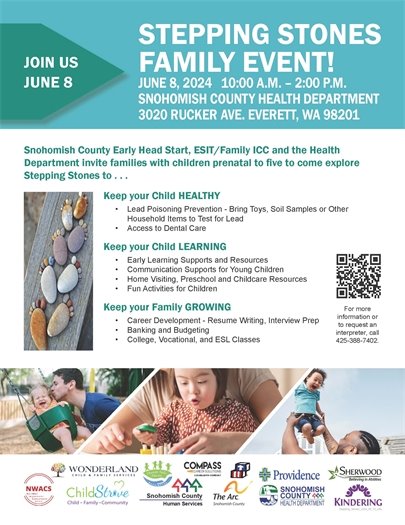
Families with children prenatal to age five and child care providers are invited to stop by the Snohomish County Health Department building for a fun family event and resource fair. Many different groups and agencies will be there sharing materials related to keeping children healthy, promoting learning through communication supports and other resources, and helping families through career development, higher education, and financial supports. 

Take advantage of the opportunity to have toys, soil, and other household items tested for lead on the spot. It only takes a minute or so to get the results. Bring items for testing with you. 

Please share this information with families. For a downloadable copy of the flyer click here.

Image of Flyer for Stepping Stones Family Event on June 8, 2024 from 10am-2pm at Snohomish County Health Department in Everett

INDIVIDUAL CARE PLANS

The Child Care Team at Public Health Seattle-King County has excellent individual care plans posted on their website. These include new checklists that walk child care and early learning programs through the many items needed to complete a care plan. You can find these plans here. Please feel free to contact our Child Care Health Outreach Public Health Nurse if you have any questions about individual care plans. 425-252-5415 or shd.childcarehealth@co.snohomish.wa.us. 

A MESSAGE FOR FAMILIES

Please consider putting the following article up on your parent information board for families.

Jet plane in the air

TRAVELING? ASK ABOUT VACCINES!

If your family will be traveling outside of the United States this summer, ask your child's doctor whether any additional vaccinations are recommended for your destination. Vaccines can help keep your family healthy. For more information about travel vaccines, please visit the Centers for Disease Control and Prevention website - https://wwwnc.cdc.gov/travel/page/travel-vaccines  

QR Code for CDC Travel Vaccine Page
Child Care Health & Safety Classes Logo
instructions for learning portal
LMS
learning portal

We appreciate your patience as we continue to update our courses to enhance your learning experience. Classes are being offered AT NO COST at this time. 

 For questions about our online classes, contact our team at SHD.ChildCareHealth@co.snohomish.wa.us or via phone at 425.252.5415.

This Month's Featured Classes

Stress

NEW! Stress Management for Child Care Providers 

This class identifies stressors child care providers experience and suggests ways to manage these stressors. In this course, you will learn about the impacts of personal stress, job stress, burnout, and secondary trauma and how to combat these stressors with coping skills and self-care practices.

Register Here

Child chipping paint off a window frame

Childhood Lead Poisoning Prevention


Lead remains a problem in Washington State and Snohomish County. This course is designed to educate child care providers and staff on how to keep children and families safe from the harmful effects of lead. Did you know there is no safe level of lead? In this course you will learn where lead was historically used, where it is currently still found and simple steps you can take to protect children and families from the effects of lead poisoning.


Register Here

Girl brushing her teeth

Tiny Bites: Oral Health in the Child Care Setting


The most common chronic disease in children is tooth decay. This is especially true in underserved populations. This course will focus on the importance of dental health in children, pediatric oral health recommendations, and how to be an oral health advocate in the child care setting. Information and guidance is provided on nutrition, oral health practices, alternative oral health activities, and methods for toothbrushing in child care. 


Register Here

Contact Information

Snohomish County Health Department
3020 Rucker Ave., Ste. 202, Everett, WA  98201

                                                                                     
Email: SHD.ChildCareHealth@co.snohomish.wa.us

Program Phone:  425.252.5415

Website:  http://www.snohd.org/238/Child-Care-Providers

Received this as a forward? Sign up for our newsletter by clicking here.

The Child Care Health Outreach Program staff are available to consult with you on these and other health, safety, and nutrition topics by phone, by email, or at your child care facility. 

Share on Facebook
Share on Twitter
Share via Email

Snohomish County Health Department
3020 Rucker Ave., Everett, Washington

Powered by
CivicSend - A product of CivicPlus