|
|
Keeping Germs from Spreading in CHild CareIt is the time of year where colds, the flu, and other illnesses are spreading in our community. In child care facilities, they can spread very easily. There are steps that child cares can take to minimize the transmission of germs. Here are a few ideas: - Improve ventilation to increase the fresh air that comes into the room. You can do this by opening windows for a few minutes each day or adjusting the amount of fresh air that comes in through your heating (HVAC) system. You can also use an air filter to remove some of the germs. (Note: never spray chemicals into the air to try to get rid of germs).
- Wash hands more often throughout the day. Unclean hands are a common way that germs spread from person to person. Adding an additional time each day to wash children's hands can help reduce the numbers of germs. Now is a good time for a handwashing lesson.
- Remind parents to keep children home when they are sick. You can find the "Keep Me Home If" poster and other parent notification resources on our website.
- Encourage immunizations for vaccine-preventable diseases.
- Staff may consider wearing a mask. Honor a parent's wish if they would like their child 2 years or older to wear a mask during waking hours.
- Teach children proper cough and sneeze etiquette. Below is a sample lesson plan:
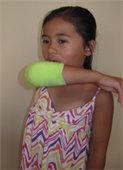
Mini-Lesson: Cover your Coughs and SneezesAsk parents to donate clean, old socks, like ones that have holes in the toe or ones that are missing their partner. Make sure all socks have been laundered. Cut off the toe to make a tube. During circle time, talk to the children about how germs make us sick and how, when we cough and sneeze, germs can come out of our mouth and nose. Have them practice turning their head towards their elbow. Pass out the sock tubes to each child and have them slip it over their arm. This gives them a target to aim for when coughing or sneezing. Have children wear it for an hour or a day, or even a week. This physical reminder will help them to develop the habit. Here is a video from Sesame Street about learning to cough into your elbow. Here is some additional information from the Centers for Disease Control and Prevention (CDC).
|
|
|
|
|
|
|
|
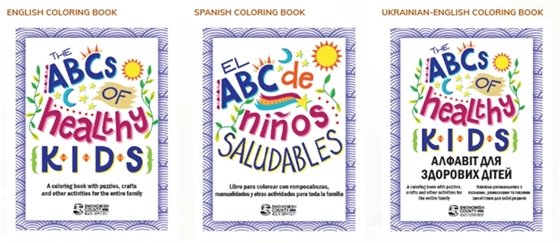
Coloring and Activity BooksThe Snohomish County Health Department has coloring and activity books available for free download on our website. Child care providers can download individual pages or the entire book. You can check it out here: https://www.snohd.org/606/ABCs-of-Healthy-Kids |
|
|
|
|
|
|
|
|
|
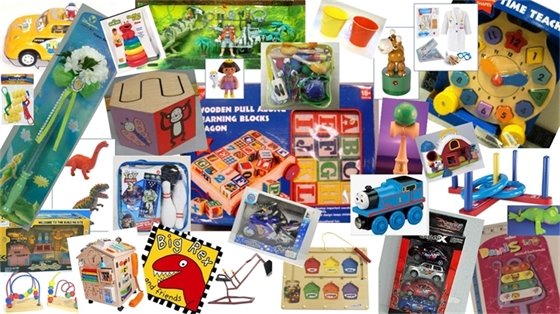
Could There be lead in your toys?Lead is a toxic metal which can harm children even in small amounts. Over the years there have been many recalls of children's toys, jewelry, craft supplies, and clothing due to the presence of lead. Lead may also be present in older hand-me-down or thrift store purchased toys. All of the toys in the image above have been recalled due to the presence of lead. You can search on the Consumer Product Safety Commission's website for products recalled because of lead (or other safety hazards). Visit www.cpsc.gov. Do any of the above toys look familiar? Have you ever wondered if there may be lead in any of the toys in your child care? If your child care is located within Snohomish County, Snohomish County's Childhood Lead Poisoning Prevention team can check your toys for you. We will pick up one box or bag of toys, test them, and then return them to you. For this pilot program, we will accept the first 10 child cares to send an email request to childcarehealth@co.snohomish.wa.us. |
|
|
|
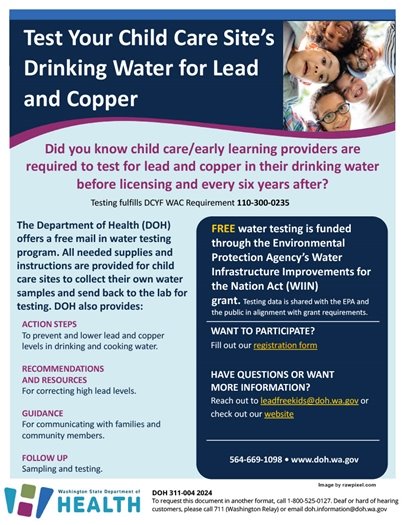
Free Water Testing from Washington State Department of HealthChild care licensing regulations require child care facilities to have their water tested for lead and copper at least once every 6 years. If you haven't had your water tested recently, it may be time to do so again. The Washington State Department of Health Lead in Child Care Drinking Water program is currently offering free mail-in water testing for child care and early learning sites across the state. License-exempt preschool and early childhood programs are also eligible to participate. The testing program checks for the presence of lead and copper in water used for cooking and drinking and fulfills licensing requirements for the Department of Children Youth and Families. For more information or to register for the program: Lead in Child Care Drinking Water | Washington State Department of Health |
|
|
|
|
|
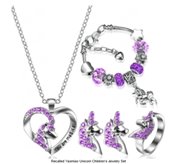
Recalled Children's JewelrYYaomiao Children’s Jewelry Sets contain levels of lead that exceed the federal lead content ban and levels of cadmium that are prohibited in children’s products by the Federal Hazardous Substances Act. Lead and cadmium are toxic if ingested by young children and can cause adverse health effects. This product was recalled by the Consumer Product Safety Commission on 1/2/2025.
|
|
|
|
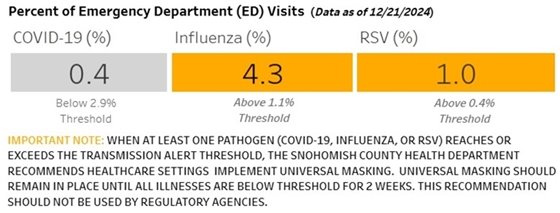
COVID-19 Information and ResourcesRemember to report all cases of COVID that occur at your child care via our website. Take a look at our Snohomish County Health Department webpage for COVID-19 resources for schools and child care. Choose the “Child Care (staff)” tab. Guidance and assistance are available from the staff of the Child Care Health Outreach Program at the email address and phone number listed below: Email: childcarehealth@co.snohomish.wa.us Phone: 425-252-5415
|
|
|
|
|
|
The Snohomish County Health Department does not currently have any more tests available to hand out. The federal government is again offering 4 COVID tests per family through the US mail. Please share the following website with staff and families and have them order kits to keep at home. www.covidtests.gov. |
|
|
|
|
|
|
|
We appreciate your patience as we continue to update our courses to enhance your learning experience. Classes are being offered AT NO COST at this time. For questions about our online classes, contact our team at ChildCareHealth@co.snohomish.wa.us or via phone at 425.252.5415. |
|
|
|
This Month's Featured Classes
|
|
|
|
|
|
Injury Prevention: Toy Safety
In addition to providing children with fun and enjoyment, toys help them develop skills, test their abilities, engage their imagination, and learn. Unfortunately, many children are injured every day from toys that are supposed to be fun. This course will focus on preventing injuries from toys in child care settings. Register Here |
|
|
|
|
|
Stress Management for Child Care Providers This class identifies stressors child care providers experience and suggests ways to manage these stressors. In this course, you will learn about the impacts of personal stress, job stress, burnout, and secondary trauma, and how to combat these stressors with coping skills and self-care practices. Register Here |
|
|
|
|
|
Childhood Lead Poisoning Prevention
Lead remains a problem in Washington State and Snohomish County. This course is designed to educate child care providers and staff on how to keep children and families safe from the harmful effects of lead. Did you know there is no safe level of lead? In this course you will learn where lead was historically used, where it is currently still found, and simple steps you can take to protect children and families from the effects of lead poisoning.
Register Here |
|
|
|
Contact InformationSnohomish County Health Department
3020 Rucker Ave., Ste. 202, Everett, WA 98201
Email: ChildCareHealth@co.snohomish.wa.us
Program Phone: 425.252.5415
Website: http://www.snohd.org/childcare
Received this as a forward? Sign up for our newsletter by clicking here.
The Child Care Health Outreach Program staff are available to consult with you on these and other health, safety, and nutrition topics by phone, by email, or at your child care facility. |
|
|
|








 Share on Facebook
 Share on Twitter
 Share via Email
