WELCOME TO THE PROVIDER PULSEFebruary 2025 This newsletter is about strengthening regular communication between the Snohomish County Health Department and medical providers. These quarterly newsletters will include up-to-date information regarding clinical best practices, current trends or emerging information, new resources, and relevant opportunities for providers and staff from all teams within the Prevention Services Division of the Health Department. INDEX: |
|
|
|
Update on PertussisPertussis cases increase in washington, remain alert for patients with symptoms- Pertussis continues to circulate in the community, and it’s important to keep it in mind when evaluating patients with persistent cough, especially if they have a known exposure.
- Ensure individuals are up-to-date on pertussis immunizations, especially infants, toddlers and adolescents. For infants and toddlers, it is very important to get the initial series of pertussis vaccines on time, as this age group has the highest incidence of unimmunized cases in Snohomish County (86%). For adolescents, make sure children are receiving the recommended dose at 11-12.
- Treat household contacts of pertussis cases to help reduce the spread of disease.
- Use PCR testing for diagnosis instead of serology.
- Report any suspected or confirmed cases of pertussis in Snohomish County to the Snohomish County Health Department.
- Call 425-339-3503 to reach the Communicable Disease program by phone.
Learn more about pertussis data and resources from the Washington State Department of Health webpage: |
|
|
|
refugee healthvaccination requirements for green card applicantsDid you know? Patients applying for a green card (I-693) may come to you for required vaccinations. It’s important to note that vaccine requirements for a green card differ from the standard ACIP schedule. Applicants should have a list of vaccines they need, but providers can also reference official guidance to ensure compliance. For the most up-to-date vaccination requirements for immigration medical exams, visit the CDC’s resource page: CDC Green Card Vaccination Requirements. Additionally, as we move further into flu season, we want to remind everyone about the importance of staying up to date on routine vaccinations, including flu, COVID-19, and RSV for eligible groups. Ensuring patients are informed about recommended vaccines helps protect our community’s health. |
|
|
|
vaccine preventable diseasesit's not too late to get your flu shot!Influenza-like illness activity continues to be at increased levels. Data from the Snohomish County Health Department Influenza Surveillance Dashboard as of 2/15/2025 shows that the percent of Emergency Department visits for influenza is currently above the 1.1% threshold at 6.7% (ED visits). There have been 335 total influenza-related hospitalizations reported for the 2024-2025 season. Overall hospitalization rate for the 2024-2025 season is 38.6/100,000 (Hospitalizations). Protect yourself and your patients from the flu – get your yearly flu vaccine if you have not yet already done so. The flu vaccine can keep you from getting seriously ill from the flu or spreading the flu to at-risk patients. To promote the flu vaccine, providers are welcome to use the Flu Free Washington Partner Toolkit from Washington Department of Health. These materials explain the importance of getting vaccinated, who is most at risk, and how to find a vaccine. You can also visit www.Vaccines.gov or call the Help Me Grow Washington hotline at 1-800-322-2588 (language assistance available) to find a flu vaccine location in your area. For more information, please visit www.FluFreeWA.org. Please keep in mind that the RSV vaccine and new COVID-19 vaccine is well stocked this year. Utilize this Respiratory Virus One Pager PDF as a guide to respiratory virus season.
|
|
|
|
children and family Healthreduce Lead Exposure in ChildrenLead exposure can have serious consequences, especially when it comes to cognitive development, learning abilities, and behavioral concerns in young children. By adopting blood lead testing as a standard part of patient care, you are taking an important step toward preventing the possible consequences of lead exposure. Blood lead testing is a simple, effective way to help protect our children and ensure that they have the best possible chance for a healthy, and successful future. Children screened for lead poisoning are more likely to receive services for behavioral problems, learning disabilities, or speech-language impairment. Symptoms of lead poisoning are not always present right away, so blood lead testing is the only reliable way to know if someone is at risk It is important to remember that there is no safe level of lead and that even low blood lead levels can have a significant and irreversible impact on children’s health. By making blood lead testing a routine part of care, you can help prevent long-term health and developmental issues. Please visit https://www.snohd.org/432/Lead-and-Health for more information and to access our provider toolkit. |
|
|
|
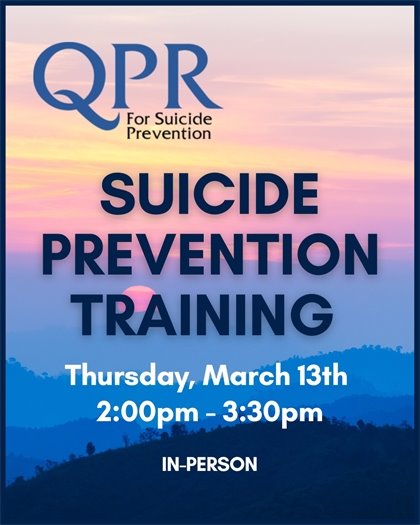
healthy communitiessuicide prevention trainingAsk a Question, Save a Life. In this 90-minute in person training, attendees will learn three steps that can be taken to recognize the warning signs of a suicide crisis and how to respond. Instruction will be provided by QPR trainer, Wendy Burchill, with the Snohomish County Health Department. The training is free and open to anyone in the community, age 16 or older. To register to attend, please use the link below, visit stillyvalleyhealth.org, or call 360-386-9918.
Date: March 13th, 2025
Time: 2:00 pm – 3:30 pm
Format: In-Person at Stilly Valley Health Connections
REGISTRATION: https://www.eventbrite.com/e/1106715819809 |
|
|
|
|
|
If you'd like to download a copy of the flyer, click here. |
|
|
|
TUBERculosisRoutine Testing ReminderAre you testing patients born outside the U.S. for TB? National data shows half of healthcare providers are considering TB for non-U.S.-born patients. Identifying and overcoming barriers to TB testing and treatment is crucial. Anyone born outside the U.S. or Western Europe should be tested for TB at least once. For positive results, contact the health department for guidance at 425.339.5225. Let's work together to reduce TB transmission in Snohomish County. Key Points to Remember: Think TB if patients have symptoms like a persistent cough, fever, unexplained weight loss, night sweats, or related radiological findings. High-Risk Groups include: - Close contacts of active TB cases
- Those with a history of residence or travel to TB-endemic regions (refer to the WHO table)
- Children under 5 with a positive TB test
- Individuals with a history of latent TB infection (LTBI), especially if diagnosed in the past 2 years
- Residents or workers in shelters, correctional, or long-term care facilities
- People with HIV, diabetes, or other immunocompromising conditions
TB-Endemic Regions (2019 Data from WHO list of high burden countries): - Severely Endemic (500+ cases/100,000): Central African Republic, Gabon, Lesotho, South Africa; DPR Korea; Philippines.
- Highly Endemic (300-499 cases/100,000): Angola, Congo, Democratic Republic of Congo, Eswatini, Guinea-Bissau, Liberia, Mozambique, Namibia, Zambia; Indonesia, Myanmar, Timor-Leste; Kiribati, Marshall Islands, Mongolia, Papua New Guinea.
- Endemic (100-299 cases/100,000): Various regions in Africa, the Americas, Eastern Mediterranean, Europe, South-East Asia, Western Pacific.
RESOURCES: |
|
|
|
|
|
 Share on Facebook
 Share on Twitter
 Share via Email
