|
|
|
|
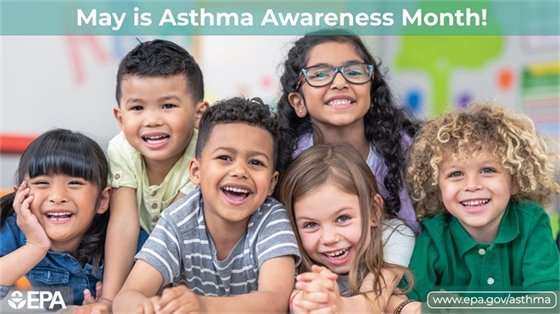
Asthma affects approximately 4.9 million children in America. This chronic respiratory disease can affect quality of life, cause difficulty in breathing, and can sometimes be life-threatening. Many children with asthma attend child care and early learning programs. There are things that child care providers can do to help: - Learn about which asthma triggers may be present in your indoor environment and the things that you can do to control them. Use a checklist like this one in English or Spanish to review your child care environment.
- Make sure that any children in your care who have asthma have a complete and easy to follow individual care plan. We advise using the care plans produced by Public Health Seattle King County.
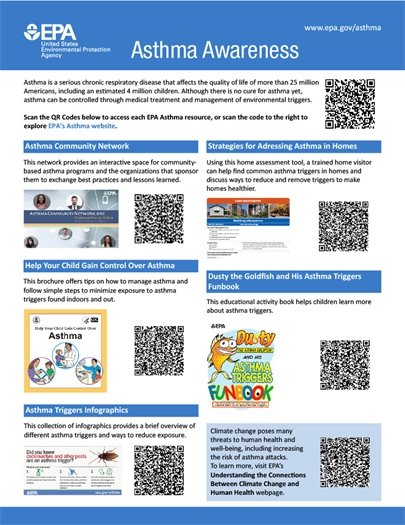
Here are some additional links to great resources from the Centers for Disease Control and Prevention (CDC), the Asthma and Allergy Foundation of America (AAFA) and the Environmental Protection Agency. You can also click on the image below to go to the handout shown or scan any of the QR codes for more information. |
|
|
|
|
|
Building upon your innate resilience “The human capacity for burden is like bamboo – far more flexible than you'd ever believe at first glance.” -Jodi Picoult Sometimes, life can be really challenging. Do you ever feel like your world is falling apart? Have you recently lived through a crisis or a very difficult time? Do you feel like there are too many demands on your time and that everyone wants something from you? Some of us have experienced a difficult loss, an illness, or an unexpected change. Most of us have had to navigate a personal challenge while we continue to meet daily demands and responsibilities. Maybe a child has had a mental health crisis that became a life and death matter. Maybe the stress of socioeconomic uncertainty or job insecurity has taken a toll on your family. Meg Jay is a clinical psychologist and the author of the book, Supernormal. In an article, she shares practical ways to overcome whatever life throws your way. Dr. Jay starts out by stating that she doesn’t think that people bounce back from adversity. She says that the words “bounce back” do not help people feel understood or seen, in light of all the complexity of their situation. Instead, Dr. Jay likes to describe resilience as a heroic struggle. “It’s really a battle, not a bounce,” she says, “an ongoing process that can last for years.” Dr. Jay has these practical tips for how you can become more resilient: - Recognize that your struggle is valid, no matter what you are struggling with. Don’t be ashamed of what makes you stressed. Some of the most common adversities are stressors that are chronic.
- Realize the ways you are already resilient. Think about the three toughest times in your life and how you got through those times. You are already resilient.
- Don’t wait for the situation to fix itself. Resilient people take action. It may not be resolved overnight, but every problem can be approached with even a small step forward.
- Know your strengths and use them. Resilient people tend to use the strengths they have and those are different for each person. If you are not sure what your strengths are, go to the website https://www.viacharacter.org and take a 10-minute survey to discover your top 5 signature strengths. When you leverage your existing strengths to tackle whatever is in front of you, the side effect is joy!
- Don’t try to do it alone. Resilient people seek support, whether it is a partner, a best friend, or a therapist. In order to fare well after adversity, it is best to surround yourself with people who care.
- Don’t feel obligated to share with everyone. Everyone’s support network looks different depending on that person. For some folks, they have two people in the world who really know them, while others may be connected to a larger community. Lean on your own support network of people you can trust.
- Find your favorite way to take a mental break. If your problem can’t be solved overnight, lose yourself in a book, engage in a hobby, or connect with a friend. It’s okay to step back and distract yourself with something you enjoy so you can avoid spiraling into a state of overwhelm. Go out in nature, play with a pet, turn off the news alerts on your phone. Sometimes the world feels overwhelming.
- Be compassionate with yourself and realize all the ways adversity has made you strong. Past struggles and stress have helped you gain confidence and prepared you for future challenges. Try to shift your perspective—if you are seeing yourself as broken, remind yourself that you are strong and resilient. You have experienced tough times in the past and you have come out more resilient on the other side.
|
|
|
|
Kintsugi is the Japanese art of mending broken ceramic vessels by sealing the cracks with lacquer and dusting them with gold powder. The golden cracks of these mended vessels make them even more precious and valuable than before. In essence, the vessels are more beautiful for having been broken. ‘Kin-’ means gold and ‘-tsugi’ means to repair, inherit, succeed, and continue. One life lesson we can draw from the art of Kintsugi is that our broken parts allow us to be reborn into something more resilient, more complete, and more beautiful for having struggled. It is with great care and intention of an artist that we can turn our broken pieces into something whole – into a unique masterpiece.
|
|
|
|
WHAT to do if there is a reportable illness at your child careIf you are informed by a family or a staff person of a case of a notifable condition at your child care, you must report that to the Snohomish County Health Department. Our Communicable Disease Nurses will provide you with guidance and next steps. Which conditions or illnesses are notifable? What do I need to report? Here is a link to the list of notifable conditions that are reportable to the health department. Some of the more common ones include salmonella, shigella, E. coli (STEC), and COVID-19. Washington State is seeing an increased number of cases of pertussis (or whooping cough) and measles. Those are both reportable as well. If you are unsure, please call us and we will be happy to help. Who do I report to? In Snohomish County, you can call the Health Department Communicable Disease Program at 425-339-3503 or the Child Care Health Outreach Program at 425-252-5415. Do I need to notify families? Please wait until you have spoken to someone from the health department before sending out a notification to families. Our nurses will evaluate the exposure and provide your child care with a letter to share with families and staff that includes information about the illness and how long they should watch for symptoms. What if I have other questions about reporting illnesses? For non-reportable illnesses, you can find fact sheets on our website. Reach out to the Child Care Health Outreach Program with any other questions. You can call us at 425-252-5415 or email us at mailto:childcarehealth@co.snohomish.wa.us.
|
|
|
|
Respiratory Illness Information Remember to report all cases of COVID and other notifable conditions that occur at your child care. Take a look at our Snohomish County Health Department webpage for COVID-19 resources for schools and child care. Choose the “Child Care (staff)” tab. Guidance and assistance are available from the staff of the Child Care Health Outreach Program at the email address and phone number listed below: Email: childcarehealth@co.snohomish.wa.us Phone: 425-252-5415
|
|
|
|
|
|
NEW RESOURCE FROM DEPARTMENT OF HEALTH The Washington State Department of Health has developed a one-page handout that has information about what to do if you have symptoms of respiratory illness, like COVID, flu, RSV, or others. The handout is available in English, Russian, Somali , Spanish and Vietnamese. Consider posting this helpful resource on a parent board or otherwise sharing with families. |
|
|
|
|
|
FREE SOIL & TOY TESTINGProtect the children you care for from lead poisoning. Lead is a toxic metal that can be found in the soil or in older or imported toys. The Washington State Department of Health Washington Choose Safe Places program will be offering free on-site soil and toy testing at the Federal Way Farmer's Market on May 17th. Bring a sample of soil or some toys and get them tested on the spot for toxic lead. Keeping Children Safe: Free Soil and Toy Testing in Federal Way For more information, email wcsp@doh.wa.gov. You can also arrange to have soil and toys tested by Snohomish County Health Department by sending an email to childcarehealth@co.snohomish.wa.us.
|
|
|
|
Is your child care on a septic system?If your child care has an onsite septic system, learning more about your system can help you protect the children in your care and possibly save you from having to make expensive repairs. We have a new class specifically designed for Snohomish County child cares who have an onsite septic system. This class is worth 2 free STARS credits and can be taken online whenever it is convenient for you. You can sign up on our Child Care Class website. Please note that this course is only available for child care providers who have an onsite septic system. If you do not have one, you will not be able to complete the course assignment and will not receive credit. We also encourage Snohomish County child cares on septic systems to sign up for the Septic Scoop Newsletter. You can do so by visiting www.snohd.org/notifyme. You can find previous editions of the newsletter here.
|
|
|
|
|
|
|
|
We appreciate your patience as we continue to update our courses to enhance your learning experience. Classes are being offered AT NO COST at this time. For questions about our online classes, contact our team at ChildCareHealth@co.snohomish.wa.us or via phone at 425.252.5415. |
|
|
|
This Month's Featured Classes
|
|
|
|
|
|
Septic Care Class for Home Child Cares in Snohomish County This course is specifically designed for Snohomish County child cares with a septic system. Please make sure this course is appropriate for your situation before registering. Child cares with septic systems are responsible for protecting the health and safety of children in their care from potential risks. Learning how to best care for your system will help create a safe child care environment. This self-paced course will cover topics including how your system works, how to find your septic system records, best practices for care and maintenance, signs of a failing septic system, how to find septic contractors and what to expect, and financial assistance options for septic systems. Register Here |
|
|
|
|
|
Injury Prevention: Toy Safety
In addition to providing children with fun and enjoyment, toys help them develop skills, test their abilities, engage their imagination, and learn. Unfortunately, many children are injured every day from toys that are supposed to be fun. This course will focus on preventing injuries from toys in child care settings. Register Here |
|
|
|
|
|
Childhood Lead Poisoning Prevention
Lead remains a problem in Washington State and Snohomish County. This course is designed to educate child care providers and staff on how to keep children and families safe from the harmful effects of lead. Did you know there is no safe level of lead? In this course you will learn where lead was historically used, where it is currently still found, and simple steps you can take to protect children and families from the effects of lead poisoning.
Register Here |
|
|
|
Contact InformationSnohomish County Health Department
3020 Rucker Ave., Ste. 202, Everett, WA 98201
Email: ChildCareHealth@co.snohomish.wa.us
Program Phone: 425.252.5415
Website: http://www.snohd.org/childcare
Received this as a forward? Sign up for our newsletter by clicking here.
The Child Care Health Outreach Program staff are available to consult with you on these and other health, safety, and nutrition topics by phone, by email, or at your child care facility. |
|
|
|
|
|














 Share on Facebook
 Share on Twitter
 Share via Email
