Food For Thought Newsletter Spring 2025 Header
Binders stacked

Updating the Board of Health Code

As part of our commitment to protecting public health and safety, we are updating the Snohomish County Board of Health Code. These updates will reflect the latest best practices in public health, which will help us respond to community needs. Updates will also help to make the code easier to understand by all users.

As we review and revise the Health Code, we want to include community perspectives across Snohomish County. This leads to better outcomes for everyone. Your input is essential in ensuring that rule changes reflect the needs of our residents, businesses, and public health priorities.

Feel free to contact us at SCBHC@snoco.org to provide comments, ideas, and suggestions for code topics that are important to you, or if there is anything else you’d like to share with our team.

We anticipate the entire code revision process will take several years. On our new Health Code Update  website you’ll find information about the code revisions that we are considering, how they might affect you, and how to give feedback or get involved in the rule making process.

We encourage you to stay updated on the latest code developments by signing up for newsletter updates. Together, we can craft regulations that reflect the unique needs of neighborhoods across Snohomish County.

Firemen fighting a fire

Fires in Food Service Establishments

Any uncontrolled fire in a food establishment should be considered an imminent health hazard. This type of fire is a significant threat or danger to public health that requires an immediate correction or an establishment to close and stop serving food to prevent injury. The establishment must notify the Snohomish County Health Department by calling 425-359-8730 or by e-mailing food.safety@snoco.org. There may also be other parties involved, such as the Fire Department, Building Department, utilities and the insurance company. 

When fires happen in a facility, the safety of food can be compromised by three factors: the heat of the fire, smoke fumes, and chemicals that may have been used to fight the fire.

Heat: Food in cans or jars may appear to be okay, but if they've been close to the HEAT of a fire, they may no longer be safe. Heat from a fire can activate food spoilage bacteria. If the heat is extreme, the cans or jars themselves can split or rupture, making the food unsafe.

Smoke Fumes: The toxic fumes released from burning materials can cause contamination. Foods that are not stored in sealed, air-tight packaging should be thrown away if exposed to smoke. Toxic fumes can get through packaging such as cardboard and plastic wrap and contaminate the food. The same concept applies to single-use articles such as napkins, service ware, and to-go containers. Refrigerators should not be considered as airtight as smoke can enter through the gaskets and exhaust vents. Open foods should be discarded in refrigerators exposed to smoke as well.

Chemicals: Chemicals used to fight fires contain toxic materials and can contaminate food and cookware. The chemicals cannot be washed off the food. Foods that are exposed to chemicals should be thrown away. 

Foods in sealed, airtight packaging such as canned goods or vacuum packaged foods, as well as cookware and utensils may be decontaminated if only exposed to smoke and chemicals. Such items must be washed, rinsed, and sanitized. To reopen, the establishment must receive written approval after a reopening inspection at the facility by the Health Department. 

Food Staff having a meeting

Food Safety Culture

Laura M. Wildey Kearse wrote an article for Food Safety News about building food safety culture. You can read the full article on the Food Safety News website.  A practical guide to building a food safety culture for retail settings | Food Safety News.

Read through her 10 ideas for strengthening food safety culture below. Each idea you choose to try will create a better environment focused on prevention. It might feel overwhelming to try all the ideas, so start with one idea at a time.

  • Food Safety on the First Day: Introduce food safety and its importance to employees on day one.
  • Continuous Conversations: Regularly discuss food safety in pre-shift meetings and huddles. Use quizzes, posters, printouts, etc.
  • Create a Pledge: Have employees commit to food safety by creating a pledge or a promise that’s signed by each team member and placed in a prominent area. Create an environment where food safety is valued, talked about, and acted upon.
  • Positive Mindset: Shift the focus from compliance to enthusiasm about doing things right. If you start thinking positively about food safety and share your positivity, others will follow.
  • Make it Relatable: Connect food safety to employees’ lives. Encourage employees to produce food items as if they were serving their closest friend or family member.  
  • From WHAT to WHY! Help your team understand more than just facts— let them know WHY food safety is so important. Your local health inspector can be a great resource here, and so can the Food Code. The Annexes at the back of the Code provide information about the “why” behind regulations.
  • Incentivize Performance: Recognize employees who excel in food safety. Non-monetary rewards work best as monetary awards can sometimes cause people to do the right thing only when someone is watching.  Use recognition programs that provide immediate, on-the-spot recognition of workers who do things correctly. 
  • Appoint Food Safety Ambassadors: Designate peer leaders who will serve as a role model for others and can be the go-to for food safety questions.
  • Measure it: Use food safety culture assessments, inspection reports, third party audit reports, observations, and employee knowledge checks to track your progress. Don’t forget to act on what you’ve found!
  • Normalize Food Safety: The ultimate goal is to make food safety the social norm. Simply make it the way you do things every day.

Certified Food Protection Manager

The primary focus of the Certified Food Protection Manager (CFPM) requirement is to increase proactive food safety, looking at things before they go wrong. This is also referred to as Active Managerial Control (AMC). This proactive approach helps to prevent Food Borne Illnesses, which can have lasting consequences. 

The CFPM will be responsible for implementing a food protection program which helps each Person in Charge (PIC) and any other employees follow the food code and maintain Active Managerial Control. The CFPM does not need to be on-site, although a copy of the certificate does. This means that not all managers need to be certified. You could have one person designated as the CFPM for the food service establishment or even several establishments. Sharing a CFPM between establishments is acceptable, but you must be able to maintain Active Managerial Control. An establishment will have 60 days to replace a CFPM if their previous CFPM leaves.

To become certified, a person is required to pass one of the American National Standards Institute (ANSI) approved FOOD MANAGER tests. This is a list of the different ANSI approved courses that will meet the CFPM Requirement.

In Snohomish County, low risk permitted establishments, temporary event food operations and school/youth activity concessions are NOT required to have a CFPM, although it is still encouraged.

Bag of shellfish with tags

Shellfish Tags

Serving shellfish can be a bit risky. There are two major illnesses that can come from shellfish: Vibrio and Norovirus. The chances of getting Vibrio are very high around June-October and Norovirus is around November-March. This makes eating shellfish a gamble almost year-round. Shellfish are filter feeders; they draw the water around them inside and then filter out food particles to eat. If the water around the shellfish is contaminated, the contamination would be on the inside, not on the outside. There is no way to tell by looking at a shellfish if it will cause an illness.  

The best way to keep shellfish as safe as possible is to purchase it from approved, reputable suppliers. Those suppliers will make sure that the shellfish comes with a shellfish tag. These tags give the harvest date and location. The tags are required to stay with the shellfish until the last of it is eaten. It needs to be obvious which tags go with which shellfish. Do not mix containers or bags of shellfish.  

The date that the last of the shellfish is used needs to be written on the tag. We recommend writing the date the bag was first used on the tag as well. Make sure to write the dates on the tags in an open space, not over the information printed on the tag. You must be able to read the tag information. The tag needs to be kept for 90 days, in chronological order, after the shellfish has been used up. This information is very helpful if an outbreak occurs. 

If a food service facility buys shellfish from a grocery store, they are responsible for getting the tags from them. Some products might not have tags if they come from another country. If this is the case, keep the invoice. If shellfish are found without tags, or an invoice when appropriate, they will be thrown away.  

Single-use service ware and condiment packets

As of 2022, businesses cannot automatically include single-use items in customer orders. The Ecology solid waste program put together a Waste and Toxics Reduction Laws flyer for food establishments summarizing the new laws about food packaging and waste reduction and where to go to learn more.

Single-use service ware and condiment packets

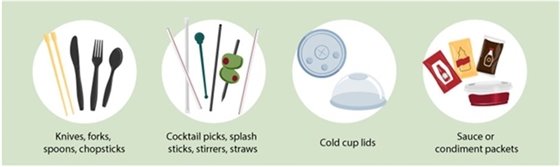
Single-use items covered by the law include plastic and compostable utensils, straws, condiment packages, and cup lids for cold beverages. Customers must verbally confirm they want these items, or they can select them from self-service bins. (Health care facilities are exempt.) For more information and downloadable flyers in 17 languages, visit single-use serviceware webpage or email SWMPublications@ecy.wa.gov.

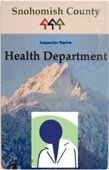
Snohomish County Health Department badge example

Check Identification

We have been hearing about people that are posing as health inspectors to gain access to food service establishments. We are not sure what their goals are but we want to make sure that you are protected. When an inspector visits your facility, the first thing you should do is ask to see their Identification. Snohomish County Health Department food inspectors always wear their ID, as well as some identifying clothing, such as a navy-blue jacket or vest with the Snohomish County Health Department logo. Please call our office at 425.339.5250 if you are unable to see the required identification. Our office will be able to confirm whether the individual is with our agency or not.

Notify Me

Sign up to receive this newsletter using the Notify Me page.

Share on Facebook
Share on Twitter
Share via Email

Snohomish County Health Department
3020 Rucker Ave., Everett, Washington

Powered by
CivicSend - A product of CivicPlus