Fall banner

Issue 23                                                                                           Fall 2025 

Vape-Free Pocket Guide preview

vape-free pocket resource 

Our updated Vape-Free Pocket Resource for youth includes information to help educate teens about the risks of vaping and highlights free nicotine cessation resources available for teens ready to quit. This printed, fold-out resource is the size of a business card and is available in Spanish and English. To make an order request (max 100 per language), email shd-tobaccoquestions@co.snohomish.wa.us.

talking to youth about suicide

As the new school year begins, it is often met with many emotions by students.  Times of transition can be especially difficult to manage for those who struggle with anxiety or other mental health conditions, and this is a good reason to refresh our knowledge about suicide prevention. Suicide is a difficult topic, but it’s too important to ignore. In Snohomish County, suicide is the second leading cause of death for youth ages 10-17. Despite a common belief that only teens and adults die by suicide, younger children can also be at risk.

Depression and suicide often coincide. Yet not everyone who is depressed attempts suicide—and not everyone who attempts suicide is depressed. If you’re a parent, a teacher, or anyone who spends time with children and teens, it’s important to learn the warning signs. These tools can help you prevent youth suicide.

Risk factors - Several factors increase the risk of suicidal thoughts or behaviors, including:

  • Mental health disorders such as depression, anxiety, and other mood disorders
  • Alcohol and substance use
  • Impulsive behaviors
  • History of trauma or abuse
  • Family history of suicide
  • Previous suicide attempt(s)

Warning signs - Not everyone exhibits the same signs that they’re thinking about suicide, but these warning signs are cause for concern:

  • Physical changes in appearance or hygiene
  • Increase in alcohol or drug use
  • Sudden drop in grades
  • Social withdrawal
  • Talking about suicide or preoccupation with death
  • Risky or reckless behaviors (such as reckless driving or unsafe sex)
  • Self-harm behaviors such as cutting
  • Talking about feeling hopeless or being a burden
  • Researching suicide methods and/or acquiring weapons

If you have any concerns about a young person’s mental health, take action. 

  • Express your concern. It’s a myth that if you mention suicide, you might plant the idea. By honestly and openly expressing your concerns, you’ll send an important message that you care and understand.
  • Really listen. Adults can be tempted to shut down an upsetting conversation by saying, “I don’t want to hear those things,” or “I had a hard time as a teen, but I got over it.” Instead, say, “Tell me more about how you’re feeling.” Then listen.
  • Maintain connection. You might want to safeguard a child or teen by keeping them home in a protective cocoon, but isolation can increase the risk of suicidal behaviors. Help a struggling child maintain connections with friends and loved ones.
  • Be compassionate. Express your love and concern for the child or teen. Tell them you hear their pain, that it can get better, that you will make sure they get help, and will support them every step of the way.
  • Trust your judgment. If a young person denies that they are having suicidal thoughts, but you doubt their honesty, trust your intuition. Take further steps to ensure their safety.
  • Prioritize safety. Remove weapons from the house, make sure the child or teen is not left alone, and consult a mental health professional right away.

Where to find help - Call or text 988 or use the chat function at 988lifeline.org
Man coughing into elbow

look out for pertussis 

Snohomish County Health Department is asking school RNs to keep a look out for pertussis (whooping cough). Although cases have decreased over the summer, due to school not being in session, pertussis is still circulating in our community. You can get pertussis even if you are fully vaccinated.  

Please encourage students or staff members who have a cough that isn’t improving, or is getting worse, to seek medical care for testing and treatment.  If a student or staff member at your school test positive for pertussis, you will be hearing from the Communicable Disease Surveillance and Response (CDSR) program. Our staff will provide public health guidelines and recommendations regarding pertussis exposures at your school. 

Please contact us with any questions, concerns, or if you have a case of pertussis in your school. You can contact the CDSR program at 425-339-3503, Option 1.  

safe aging symposium

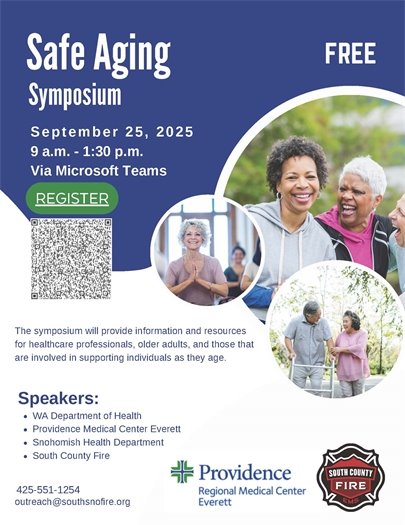
Want to learn more about safe aging? Join us at a free virtual symposium on Thurs, September 25th, 9am - 1:30pm. The symposium will provide information and resources for healthcare professionals, older adults, and those that are involved in supporting individuals as they age. See the flyer for more details. Click here to register.

Safe Aging Symposium flyer

Click here to download a copy of this flyer.

Safe firearm storage

Be SMART Webinar – Secure Firearm Storage Saves Kids' Lives

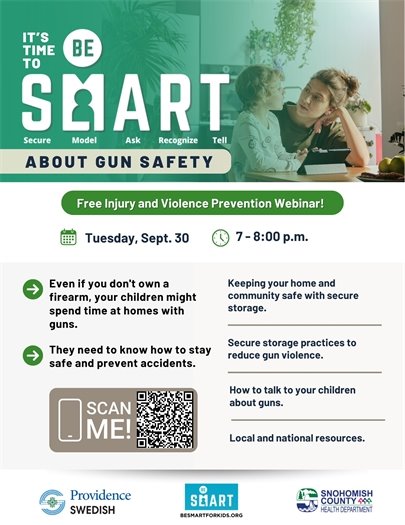
Join us for a free 1-hour Injury and Violence Prevention webinar on Tues, September 30th,  7:00 – 8:00 p.m with Be SMART and the Snohomish County Health Department, hosted by Providence Hospital. Be SMART is a public education campaign that focuses on preventing child gun injuries and death by promoting responsible gun storage and ownership. Learn more about Be SMART: Be SMART | Secure Gun Storage.

Be SMART Gun Safety Webinar

Click here to download a copy of this flyer.

senior fall prevention

Learn how to stay safe and confident on your feet with guidance from a guest speaker from Providence Regional Medical Center Everett, taking place at all six Snohomish County YMCA’s during the months of September and October. This informative session will cover what defines a fall, why it's important to talk about falls, current data and statistics, common risk factors, what life can look like after a fall, and practical strategies for prevention.

Click here to view dates, times, and locations. The talks are free to everyone, no Y membership is required, however if you are not a Y member you will need to arrive early to obtain a guest pass.

Share on Facebook
Share on Twitter
Share via Email

Snohomish County Health Department
3020 Rucker Ave., Everett, Washington

Powered by
CivicSend - A product of CivicPlus