What the Snohomish Health District is Doing With SchoolsThe Health District and local school districts work together to keep kids safe and healthy. Staff from multiple Health District programs visited all 15 school districts in Snohomish County during the first half of 2019. Their work included inspections, trainings and providing health-related information and guidance.
Over the course of six months, from December 2018 through May 2019, food safety staff completed more than 130 inspections of school kitchens and satellite kitchens, and nearly 20 inspections of concession stands. Environmental health specialists also inspected school buildings – about 60 of them, all over the county.
The Child Care Health Outreach team answered questions about sanitizing surfaces and handling food safely in child care settings. They’ve also shared their expertise in responding to illnesses in early childhood education programs.
Our Healthy Communities team worked with school staff, students and parents on topics from preventing drug use to promoting exercise. Events such as “Not in my House” focused on stopping teen substance abuse, while suicide prevention trainings for staff, student groups and parent organizations aimed to prepare people to help others in times of crisis. Also, a new alternatives to suspension program taught students who were caught using e-cigarettes about making healthier choices. This summer, we put on a physical activity program in Everett and Sultan. The first day drew nearly 30 kids, all ready to run.
Summer may be a break from classes, but it doesn’t stop the work we do with our schools.
|
|
|
|
MMR Vaccine Exemption Law Change 2019In 2019, the Washington State Legislature passed a bill that removes the personal and philosophical option to exempt children from the MMR (measles, mumps and rubella) vaccine required for school and child care entry. It also requires employees and volunteers at child care centers to provide immunization records showing that they have received the MMR vaccine or proof of immunity to measles. The bill was signed into law by Gov. Jay Inslee on May 10.
To help answer questions and share the current status, DOH has created an exemption law change webpage at www.doh.wa.gov/MMRexemption. This page contains information and resources on school and child care immunization requirement changes. The page is being updated as more information becomes available.
The recent measles outbreaks in Washington and the ongoing outbreaks across the United States demonstrate why the change to the vaccine exemption law will help keep Washington healthy and safe from three serious diseases. DOH will continue its work in helping parents and the public understand the safety record of vaccines and the critical role they have in saving lives. |
|
|
|
Things to Remember When Visiting Petting ZoosPetting zoos are popular spots for children during the fall. While learning about animals and how to interact with them is fun and valuable, it’s also important to remember that animals can expose children to potentially serious illnesses. E. coli, salmonella, giardia, and worms are among the 30-plus diseases that can be spread by animals. Children are at a higher risk from these types of illnesses than adults. They are also more likely to put their hands in their mouths and not wash their hands well enough. Some children also may have allergic reactions to animals.
Keep children (and adults) healthy when interacting with animals by following these tips: - Make sure there are washing stations that are easily accessible and stocked with soap and warm water.
- Wash hands thoroughly with soap and running water after touching an animal or going into an animal’s living space.
- Eat snacks or meals before petting the animals or eat in an area that is separate from all animals, after washing hands thoroughly.
- Make sure children are supervised and that they don’t attempt to kiss the animals, share food or toys with the animals, or put their fingers in their mouths after touching animals.
Even animals that appear healthy can have germs in their hair or fur, mouth, manure, drinking water, or habitat. Assume every animal carries germs that could make you ill. Approach animals with respect and caution, as even normally non-aggressive animals can be provoked into biting or scratching. Never let children interact with petting zoo animals unsupervised.
|
|
|
|
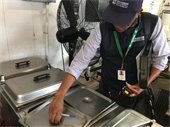
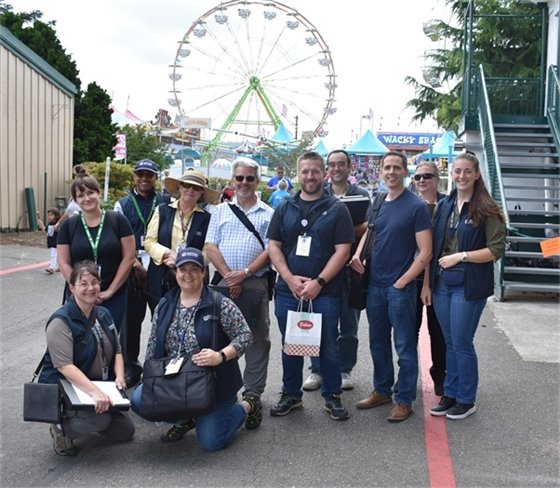 The Environmental Health Food Safety team was out at the Evergreen State Fair for opening day. They inspected over 70 food booths, rest rooms, handwashing stations, barns and the petting zoo to help keep the public safe.
|
|
|
|
Temporary Permits for PTA EventsWe often get questions about the need for a temporary permit for a PTA or other sponsored event involving the school.
Temporary permits are required for any specialized school event, publicly advertised, that involves food preparation or service to the public by individuals that are not school kitchen personnel. The public would be considered anyone who is outside of the school population. The school population is the students, staff and the families of students and staff. If the public is invited and they are charged a fee for food, a temporary event permit is required. If the public is invited and the food is given away without a charge, a temporary permit is still required.
Temporary permits must be purchased seven days before the event from the Snohomish Health District.
The special event could be under the school kitchen annual permit if a kitchen staff member is on-site to monitor the event as the designated Person in Charge.
The exception to that is if a barbecue is planned for the school, outside of the main kitchen area, a temporary permit will always be required.
If you have any questions, call the Snohomish Health District at 425.339.5250 or go to our Temporary Food Booth page on our website.
|
|
|
|
StandardizationThis spring, the Health District Food Program began implementing an FDA-modeled evaluation tool designed to assess and promote greater uniformity of retail food inspections. This evaluation tool, known as Standardization, uses a rigorous and systematic procedure to confirm each field inspector can demonstrate a high level of knowledge, understanding, and application of the food code against a uniform system of measurement.
One of our team leads, Zach Christopher, is a Washington State Department of Health Standardization Officer, and will be standardizing the rest of the team. One aspect of standardizing the team involves joint inspections with the Standardization Officer. This means they will each perform an inspection at the same time and then compare their inspection reports. They are only allowed a few differences.
The standardization process is not meant to turn each inspector into a robot. There will always be a human element to an inspection. Each inspection has its own considerations. However, through standardization, the goal is to provide a more consistent focus on risk factors, and a more uniform application of both the food code and Snohomish Health District policies and procedures. Our goal is always to keep the public safe from foodborne illnesses and improve how we do that.
|
|
|
|
Changes for the Manager Certification Class
|
|
|
|
Due to the proposed food code changes coming in May 2020, the Snohomish Health District Manager Certification Class is currently under review. We plan to take this time to come up with a class that meets the needs of our customers and meets the new food code. We will be sending out more information on our new Certified Food Protection Manager Class options in the next newsletter. For questions, please contact Leah Tax at 425.339.8752 or ltax@snohd.org.
|
|
|
|
|
|
|
|


 Share on Facebook
 Share on Twitter
 Share via Email
